


This website uses cookies so that we can provide you with the best user experience possible. Cookie information is stored in your browser and performs functions such as recognising you when you return to our website and helping our team to understand which sections of the website you find most interesting and useful.
Categories
CEVA Logistics, ENGIE, SANEF kick off PoC for low-carbon, long-distance road transport in Europe
Read time: 3 minutes
The proof-of-concept project covers 900 kilometres between Avignon and Lille in France, with four highway segments between five relay stations. Over a two-year period, it will test in real-life conditions low-carbon, long-distance freight transport on France’s highways.
CEVA Logistics, ENGIE, and SANEF—partners in the European Clean Transport Network (ECTN) Alliance—launched the proof of concept of the low-carbon, long-distance road transport network.
First announced in March, the Network’s pilot programme covers a distance of more than 900 kilometres in France between Avignon and Lille, aiming to demonstrate the ECTN concept to facilitate the decarbonisation of long-distance road freight transport. The concept would not require specific technological innovations, but rather relies on a network of terminals for low-carbon truck refueling and trailer exchange.
By providing transporters with a solution based on alternative energies to diesel for long-distance freight transport, the concept addresses shipping customers’ demands for decarbonising their cargo flows, while also aligning with the growing need for energy transition.
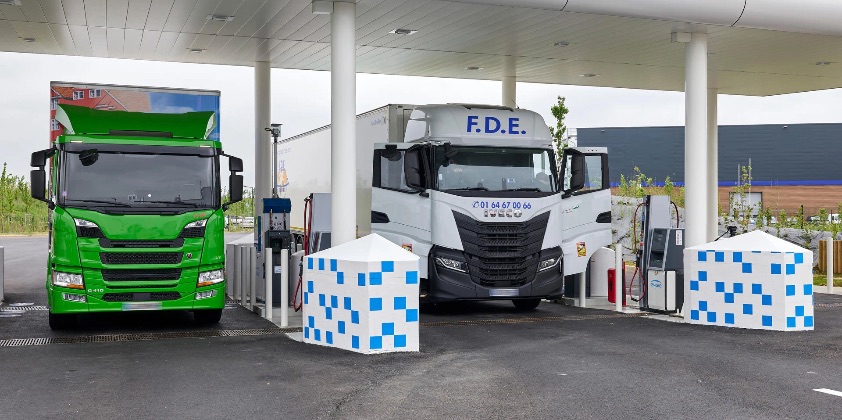
The Alliance’s concept draws inspiration from the traditional “relay” concept by establishing relay stations equipped with electric charging stations and bioCNG refueling pumps for trucks along the existing highway network. At these relay stations, trailers are disconnected and reconnected to a new tractor unit and driver for the next segment for transport.
The test route between Avignon and Lille is divided into four segments between: Avignon (Vaucluse) – Lyon (Rhône) – Dijon (Côte-d’Or) – Sommesous (Marne) – Lille (Nord). Each truck completes two round trips per day between two of these relay stations. This daily round-trip principle on a defined road segment contributes to improving working conditions for truck drivers and making the profession more attractive by reducing the distance travelled between home and work.
Each member of the ECTN Alliance is contributing its expertise to the implementation of the pilot. CEVA established relay stations at its Avignon, Lyon, Dijon, and Lille branches and has set up a control tower in Valenciennes to supervise cargo flows and to monitor transit times and energy consumption. ENGIE is installing and operating electric charging stations and biogas distribution pumps. SANEF is hosting a relay station at its Sommesous service area.
Starting initially with four bioGNC trucks operated by F.D.E. Transports, the pilot will gradually expand to include 16 trucks, including 12 electric ones, and will welcome new transport partners and shippers. Ultimately, the programme aims to enable the 16 semi-trailers to traverse the network five days a week—eight traveling northward from the Marseille-Avignon commercial area and eight others to travel southward from Lille.
Major names in commerce and industry, such as Intermarché Food Logistics and Heineken, are expressing their interest in the ECTN concept and are participating in the trial, entrusting some of their cargo flows to be transported through the ECTN network.
The ECTN concept is designed to be open to various stakeholders, including trucking companies, truck drivers, shipping customers, energy suppliers, motorway operators, truck manufacturers, and public authorities. All stakeholders are invited to participate in the Network’s development and the proof of concept.
Processes and software tools will be developed and improved to transmit low-carbon traction certificates to customers with unprecedented precision and ensure real-time supervision of the complete system, including the 16 low-carbon trucks, six electric charging stations, and numerous bioCNG refueling stations.
Simultaneously, a feasibility study has been launched by a team of experts in logistics (CEVA), motorway management and operation (SANEF), and low-carbon, heavy-duty mobility (ENGIE), as well as experts from ENGIE Impact and Carbone 4. The study aims to model the entire concept as it might eventually be deployed across Europe. Expected in the coming months, the results will provide an estimate of the Network’s potential contribution to decarbonise long-distance road transport at the European level. The study will also outline the conditions that would enable the concept’s full implementation.
Luc Nadal, Managing Director of CEVA Logistics Europe, said, “The ECTN project has been more than two years in the making. By combining the skills and expertise of three major French companies, with the support of our partners and customers, we have brought together all the conditions needed to provide a concrete response to the critical challenge of decarbonising road freight transport in Europe. When we see what is happening with the electric car, we can make that possible for heavy goods vehicles, with the support of European public authorities. This experiment is a first step towards a large-scale transformation of our industry, with considerable benefits for the environment.”